The Story Behind the Campaign
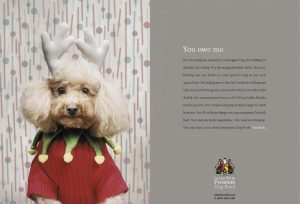
You Owe Me.
For carrying me around in a designer bag. For talking to
me like I’m a baby. For throwing invisible sticks. For not
letting me say hello to your guest’s leg in my own
special way. For taking me to the vet’s without telling me
why. For not letting me show next door’s cat who’s the
daddy. For naming me Princess Fifi Trixabelle Emilia
Fortesque III. For sur pressing my natural urge to sniff
bottoms. For all of these things you owe me prime Scottish
beef. You owe me fresh vegetables. You owe me vitamins.
You owe me Lucies Farm Premium Dog Food. Go fetch.
In the spring of 2004, Craig came into the kitchen at Lucies Farm and said, with the particular expression he reserves for things that are either very good ideas or very bad ones, “There are two Australians on the phone who want to advertise our dog food for free.”
I told him to find out more before agreeing to anything.
He did. And then we agreed to everything.
The Australians
Matthew Keon and his colleague were social marketing pioneers from Sydney. FCB London — Foote, Cone & Belding, one of the world’s largest advertising agencies — had recruited them, paid to relocate them to London, and essentially given them a blank canvas: find something interesting to promote.
Social marketing in 2003 and 2004 was genuinely new territory. YouTube did not yet exist. The idea that a campaign could spread organically without a conventional paid media budget was considered eccentric by most of the industry. Matt and his colleague were among the few people who understood how it might work.
Out of everything they could have chosen to champion, they chose us: a small farm in Worcestershire making fresh, refrigerated dog food from prime Scottish Kobe beef and Kurobuta pork. I have never been entirely sure what made them pick up the phone. I am very glad they did.
The Campaign
What they produced, at no cost whatsoever to us, was one of the most charming pieces of advertising I have ever seen.
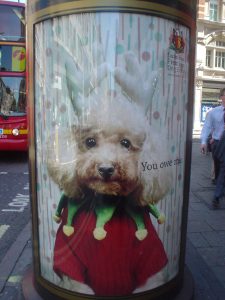
The model was a Poodle in a jester outfit with antler headgear, wearing an expression of magnificent, long-suffering dignity. Matt told us afterwards that they had needed to license an existing photograph rather than shoot afresh — they were up against a deadline and a reshoot wasn’t possible. The licence cost £600.
For £600 and the brilliant instincts of two Australians a long way from home, that photograph appeared as a double-page spread in the London Evening Standard and on a dozen or more of the round poster columns on Oxford Street in London.
I remember seeing one of the Oxford Street posters for the first time. A red London bus was going past. There was our dog food, full-size, on one of the busiest shopping streets in the world. Craig and I looked at each other and said nothing for a moment.
The Phone Calls
In the days after the Evening Standard ran the ad, we started receiving calls from other national newspapers. Each one had seen it and assumed we had a substantial advertising budget. Each one offered to run the ad at what they described as a preferential rate — less, they assured us, than whatever we had paid the Evening Standard.
I explained that we had paid nothing to run the ad in the Evening Standard.
The conversations became quite short after that.
The ad may have run a second time somewhere. Things were moving rather quickly and I was never entirely sure. On the whole I think it probably did.
The Problem We Couldn’t Solve
The campaign worked. People saw it, talked about it, wanted the product. Retailers were interested. Enquiries came in.
And then they asked where they could buy it. And we had to explain that it needed to be refrigerated.
In 2004, supermarkets did not have refrigerators in the pet food aisle. The pet food aisle was ambient — tins and bags on shelves at room temperature. Our product was fresh. It needed to be kept cold. The two things were simply incompatible, and there was nothing to be done about it.
We could sell directly. We could supply specialist pet shops with their own refrigeration. But the mass market — the supermarket shelf that the Oxford Street campaign was pointing at — was not ready for us.
It is, in retrospect, one of the more frustrating experiences of our time at Lucies Farm. The idea was right. The product was good. The campaign was wonderful. The timing was simply wrong.
Twenty Years Later
In 2012, a company called The Farmer’s Dog was founded in New York. Its premise was simple: fresh, human-grade dog food, delivered refrigerated to your door by subscription. By 2023, it was valued at over a billion dollars.
Freshpet, Ollie, JustFoodForDogs, Butternut Box in the UK — fresh refrigerated dog food is now one of the fastest-growing categories in the entire pet industry. Supermarkets now have refrigerators in the pet food aisle.
We were doing this in 2003.
I try not to dwell on it.
A Postscript
Matt Keon got in touch again recently — twenty years is nothing when you have made something worth remembering together. He is still out there, still thinking laterally, still finding things worth promoting. You can find him at @mattkeon.
Some things stay with people.
If you’re reading this, Matt — thank you. For the Poodle in the jester outfit. For Princess Fifi Trixabelle Emilia Fortesque III. For “Go fetch.” For the newspaper calls that went very quiet very quickly. For all of it.
You Owe Me.
Marjoire Walsh
Honolulu, Hawaii
April 8, 2026